



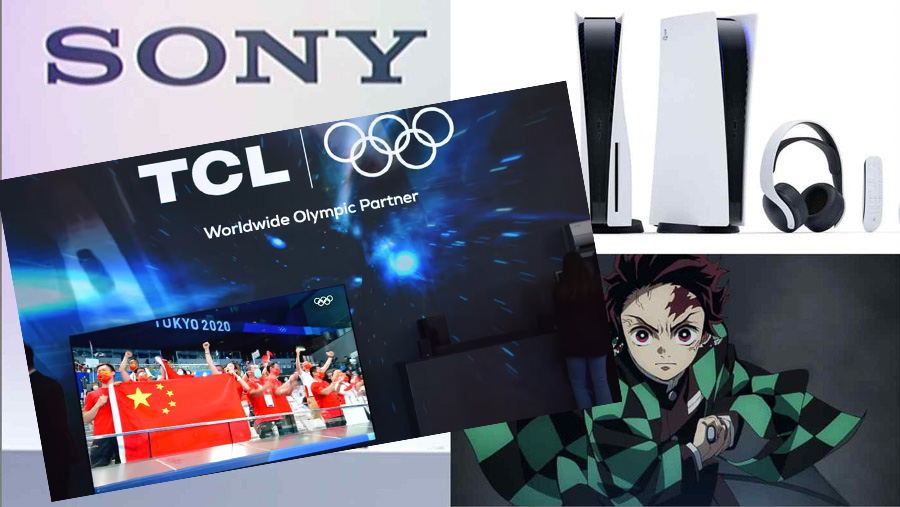
The industry is all abuzz ever since this past Tuesday, when Sony Corporation announced that it has signed a Memorandum of Understanding (MoU) with TCL “for strategic partnership in home entertainment field.” The announcement goes on to describe, in really sketchy terms with virtually no details, an idyllic or almost utopian vision of how this “partnership” would operate.
But it’s all code. The media has scrambled to spread the news of what they know…which is virtually nothing. Let me help you decode the important meaning of this announcement.
Learn more about this new Sony & TCL ‘partnership’…
The entire announcement released by Sony Corporation in Japan totals just four short paragraphs. In it, they describe the beginning of a beautiful partnership, with – in effect – Sony and Bravia TVs living on in harmony forever. Imagine combining Sony’s spectacular technology and brand IP (intellectual property) combined with TCL’s manufacturing muscle and global market share – the skies open…warm, refreshing rays of sunlight shine down on the world…heavenly trumpets play…the angels sing…yadda, yadda, yadda.




I’m here to tell you that I think that it’s all baloney. Full disclosure – I know no more than any other media outlet that claims to know what’s going on. But after working for a Japanese company for 14 years and closely following the industry – with a focus on Japan and a specific focus on Sony…as viewed through its local media – I have a distinct view on what is truly going on here. However, to be clear, the views expressed here are my own.
So here, in somewhat random order, are my thoughts on this new supposedly golden partnership…
Another Casualty of the Shift to Digital TV
Sony, for many years, was the leading TV brand during the days of analog TVs. The company had invented a remarkable technology known as the Trinitron picture tube. Trinitron was viewed by many industry experts as the finest picture tube on the market. Sony used this reputation to build a huge TV business, with Trinitron – for them – guaranteeing better profits from its TVs than competitors could gain from the highly competitive non-special analog TVs. Consumers were willing to pay a little more – for the best.
How do I know that Trinitron was so important to the company? Simple! Japanese manufacturers regularly had technology breakthroughs, which they would brand and use for market advantage for a couple of years. Once the pull of that technology is demonstrated, they then go to all the other manufacturers (their competitors) and license that technology to them. This gives the company a “have your cake and eat it too” opportunity. Done correctly, those brands would profit more from licensing than they did from selling their own products with the technology.
However…Sony never licensed Trinitron.
Sony Did Not Enjoy the Same Priority in the Shift to Digital TV
The company amplified its TV success by driving a greater video products business, in part due to Betamax analog videotape business (which ultimately lost out to VHS, but remained a mainstay of professional/industrial video production studios and newsgathering organizations for decades). I was a Sony fan…owning both a Sony Trinitron TV and a Betamax videotape recorder.
But in the shift to digital video technologies, Sony was never able to replicate its “Trinitron” success. Try as it might, the company was never able to invent a proprietary technology that gave it the same kind of a market advantage in the digital TV segment. This not only relegated it to the lower status of just another TV provider, it also caused it to be subject to the same competitive pressures as all of the other providers.
Losing that profit protection that the Trinitron technology afforded it was painful. Even more importantly than that, losing the reputation as the leader in TV technology foreshadowed the likelihood that it would be a fatal blow to Sony’s continued commitment to the INSANELY competitive TV business.
The Same Weapon Japanese Brands Wielded to Take Out American TV Makers, S. Koreans Used Against Japan; And Now the Chinese are Using Against S. Korean Makers
Ironically, the same bullet that allowed Japanese TV makers like Sony, Panasonic, Toshiba, Hitachi, NEC, and others to slay the American TV manufacturers’ previous market dominance – a systemically lower cost of production in Japan – has now served to ravage the Japanese TV business.1 First, South Korea offered a lower manufacturing cost than Japan, benefiting brands like Samsung and LG. This began the degradation of the Japanese brands’ market share, ultimately winning the business from them and taking them out.
Now, China is poised to use its lower mass manufacturing costs to topple the South Korean makers. The circle goes round and round. Remember, TCL is a Chinese company.
I’ve reported on the massive restructuring that the Japanese TV business has gone through, with everyone up to and including the Japanese government, trying to save the industry. The truth is that those brands that have survived will likely lose out as China rises in prominence.
I’ve Been Watching Sony Closely for Decades
Almost from the day I launched Strata-gee, I have kept a close eye on global technology industry leader Sony Corporation. The Japanese are well-known as long-term planners. Konosuke Matsushita famously presented a 250-year business plan. He did this to demonstrate a deeply held commitment to intergenerational and sustainable business development.
If you watch closely and pay attention, Japanese public companies will tip their hand and show you where they are going. I’ve been watching closely. I’ve been paying attention. Slight moves today, could have huge impact tomorrow…even if that tomorrow is ten years down the road.
And I’ve shared my findings repeatedly with Strata-gee readers.
I’ve Been Warning You of This Day for More Than a Decade
Since the Sony announcement went out on Tuesday, I’ve spoken with many in the industry who are shocked by this news. Many are confused and highly concerned as to what this development means and wonder about the dimensions of the “partnership.” Some are quite dismissive that this is anything serious – it’s just a joint venture they say, with a hint of a question mark in their tone. Isn’t it? Some are angry when it is suggested that this is anything other than a new, powerful partnership. That is just wishful thinking. Go ahead, whistle in the dark and maybe nothing scary will jump out at you. Or maybe it will.
In 2015, I wrote a post titled, After Fighting Idea for Years, Sony is Ready to Dump TV, A/V, & Smartphone Businesses. This was the hand tipping I referred to. Company CEO at the time, Kazuo Hirai admitted the company’s three-year plan had failed…generating losses. The new plan then was to prioritize profit generation over revenue growth. This post was the canary in the coal mine.
I revisited that topic many times over the ensuing years as the company began to clearly demonstrate its day-by-day incremental movement to tear down the structure of the old hardware-centric/low profit business and build a new software-gaming-online subscription-content-anime-services/high profit one.
Starting in 2020, Things Began to Accelerate
In 2020, for example, I posted Sony to Close Major Malaysia Audio Factory; Begins Refocus Away from A/V.
Then,in 2021, in rapid succession I posted in January, CES 2021: Sony Evolves From Hardware Maker to Experience Creator…then in February, Sony’s Strategic Shift From Hardware to Services Pays Off; It Now Projects Record Profits…and in May, Sony Doubles-Down on Transformation from CE to Gaming, Media, & Services
There was more, but I think you get the picture. So for those who paid attention, this weeks development was less of a surprise.
Is the Sony/TCL Announcement Really About a Partnership?
I told you the rather terse announcement was only four paragraphs long. Here, out of all of that verbiage, is the only pertinent fact:
The so-called joint venture will take over Sony’s home entertainment business – TV and audio (and perhaps more), “with TCL holding 51% and Sony holding 49% of its share.” That’s all I need to know. This is a TCL company. Yes, Sony is participating in the profits – to some unnamed degree – but TCL, as majority owner, calls the shots.
Bloomberg News originally announced this transaction as Sony selling TCL its TV biz (including Bravia) and its audio business…and that effectively is what it is. When the deal closes (if the deal closes), minority owners like Sony will no longer have any control and minimal say in its operation. As the majority owner, it is a TCL company.
It is my perspective that Sony is in the process of a final exiting of the consumer TV and audio business – as it has been planning for years. TCL will soon license IP and control Sony TVs, Bravia TVs, and various Sony audio gear. This “partnership” is likely an interim step towards Sony’s full withdrawal from these legacy businesses.
However, this transaction will add to TCL’s rapidly expanding share of the global TV business and potentially allow it to leapfrog Samsung, the world’s largest TV brand.
Fun Fact: Onkyo in Japan (not associated with Premium Audio Company here in the US) is providing certain TCL premium TV models with upgraded audio and has been for years.
Remember, This is Only an MoU
Finally, let me remind you that this is only a memorandum of understanding. That is little more than an announcement that the two are going to talk about a deal. As of today, there is no deal…only an understanding that the two companies are going to talk about it.
The next step is to create a complete and binding agreement with all T’s crossed and I’s dotted. That is a difficult step and there is plenty of opportunity for it to potentially fall through. And once an agreement is made, they will also need to file globally for regulatory approvals.
The announcement notes this, saying that: “Sony and TCL will proceed with discussion toward executing definitive binding agreements by the end of March 2026.” If all goes well, then TCL is expected to take over in April 2027.
I fully expect this deal to go through, as Sony is a motivated seller.
Finally…
We have no information or idea what this means for those in the custom integration business. Sony had maintained a commitment to this channel. TCL will not be bound by that, but may seek to maintain those relationships as well. It’s a “wait and see’ situation.
Going forward, keep in mind that Sony TV’s in that new era will not be made by Sony, rather they will be products of TCL. And TCL, makes a darn impressive TV product.
FOOTNOTES
- Although I should note that, to be fair, low labor costs weren’t Japan’s only advantage, Japanese manufacturers were effective at advancing TV technology as well. Still, the cost advantage was huge. ↩︎



In early 2000’s, TCL and Thomson (s RCA) put together a “joint venture” for Thomsons TV business. A couple (few?) Short years later TCL owned the business. Ted’s instincts on this may be on the nose.
Hi Sam,
Thanks for sharing your thoughts. I rarely profess to be able to divine the future…but I’ve seen this movie before.
Thanks for reading Strata-gee!
Ted
I saw a 100″ TCL at Costco for $1499 (or was it $1299?). It looked very good. Pretty tough to compete against that. As you say, the television business is brutally competitive. Many years ago, when I had my rep firm, we sold Hitachi TVs. They had, as you will remember, a joint manufacturing venture with Fujitsu in Japan to make the then new flat panels. Fujitsu exploited the consumer TV space, albeit at pricing that now seems shockingly high, and did well for a few short years. Hitachi took a long look and said, “nah, we’ll build ships, bulldozers etc”. and exited the TV business. It was a frustrating development for me, but I understood their logic. They weren’t wrong and it’s only gotten steadily worse. I just saw that Amazon will begin selling a competitor to Samsung’s popular Frame TVs (I own one…fantastic and novel concept) under the FireTV brand at very low pricing. It’s a crazy space.
There is opportunity for premium in video, but less and less in TV. Projectors are still a staple for high-end home theater and video walls are growing in popularity. I wonder what Sony will do in those categories in the years to come?
Hi Doug,
What’s going on in the TV category? Well, I saw a Vizio 55” 4K Ultra HDTV SMART LED TV for just $159…AT MY GROCERY STORE! Keep in mind, many consumers consider Vizio to be a top brand name.
Re: Sony’s plans…I think it’s to fully exit the hardware business and let others fight over the race to the bottom.
Thanks for sharing your perspective!
Ted
Ted,
Your history lesson is quite accurate and cogent. The number of manufacturers has been winnowing for 20 years if not 30 years. Where are the Magnavox, Zenith, and RCA console TVs in Mediterranean style? Motorola TVs we’re the finest until Sony usurped their position. It’s been a good run, but the important thing here is how does the CI integrator protect their niche which Sony so handsomely supported.
The answer is the realization that dealers are not in the “sales business” but rather the “service business”. Gone are the days of building your business on exclusives and limited distribution brands.
It’s just a new challenge for a business built on trial and error with no standards. Smart dealers will adapt and flourish but not because of the support of our old friend Sony. Charge!
Former Pioneer product planner/marketing guy here, and former global brand manager and product developer for Onkyo, Integra, Pioneer and Elite, 25 years combined.
Briefly:
TCL’s TVs will experience a brief uptick in prices, due to absorbing increased production and joint-venture technology R&D and retooling. That will take unsuspecting TCL consumers by surprise, and probably not in a good way.
Meanwhile, Sony’s rabid fan base will unquestionably turn a cold shoulder in what they perceive to be Sony’s betrayal. Sony-branded TV sales will drop noticeably, while at the same time premium Sony prices will start to fall, thanks to increased production numbers via TCL, further diluting their star power.
At both Onkyo USA and PAC, we suffered very poor sales numbers of Onkyo, Integra, Pioneer and Elite thanks entirely to all of Japan’s blind insistence to them sharing a common platform architecture (something I was working desperately to tear down and rebuild as very different and competitive designs right until the end) (and now, of course, Pioneer home theater products are almost certainly extinct and a sorry footnote in audio history).
Countless resellers would always demand “Why am I expected to buy Pioneer/Elite with a lesser warranty for more, when I can get the same thing for less with Onkyo/RZ?” and, more damaging “Why am I paying a premium for Integra when I can get the same thing for less with an Elite?”
With Sony and TCL sharing everything, they are going to very quickly find themselves in a similar situation.