




In a surprising new survey of 141 of the Fortune Global 500 Chief Executive Officers, the leaders of some of the largest companies in the world, we learn that they are losing confidence in the U.S. economy. The survey, conducted by The Conference Board, a nonpartisan think tank, and The Business Council, an association of CEOs, showed a significant decline in CEO confidence in the second quarter of 2026 as compared to the first quarter.
How CEOs feel about the economy is important. When CEOs lose confidence, they tend to pull back on hiring and investment, further weighing down the economy, according to AXIOS reporter Emily Peck.
Read more on the dramatic drop in CEO confidence in the U.S. Economy…
It was a surprising turn of events, as most CEOs were fairly confident in the economy in the first quarter of 2026. Then, in the second quarter, sentiment turned south. The main culprit bumming out CEOs appears to be the Iran war dragging on, driving up the price of oil, and increasing overall inflation.




Optimism Among Leaders Plunged in Q2
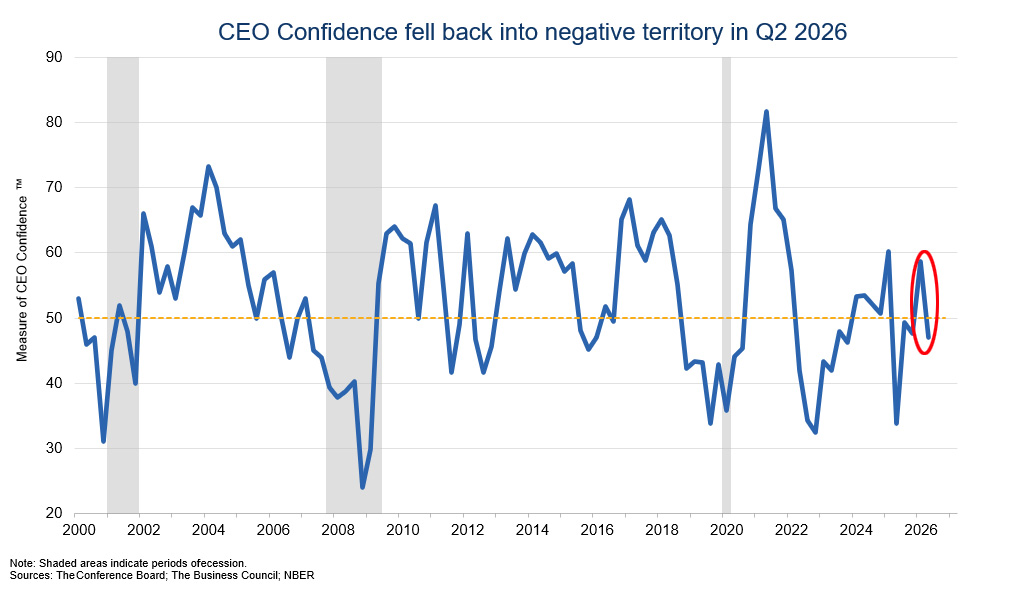
Second-quarter CEO confidence came in at a reading of 47, a 12-point drop just since February, when it read a more robust 59 points. The Conference Board said plainly, “…optimism among leaders of large firms plunged.” This big drop puts CEO confidence in negative territory, as a reading below 50 “…reflects more negative than positive responses,” the Conference Board said.
CEO confidence fell back into negative territory in Q2 2026, reversing the surge in optimism in the first quarter. CEOs reported that the economy is materially worse now than it was six months ago and expected economic conditions to weaken further over the next six months. Regarding their own industries, CEO assessments about current conditions and expectations in six months deteriorated since last quarter.
Dana M. Peterson, The Conference Board’s Chief Economist
Other Surprising Results
There were other surprising results as well. For example, in the first quarter of 2026, 39% of CEOs said economic conditions were better than six months ago. But in the second quarter survey, only 15% said that…a 24-percentage point or 61.5% drop.
Along the same line, 47% of CEOs in the Q2 survey said economic conditions were worse. In the Q1 survey, only 8% said that.
Cyber and Geopolitical Risks Top the List of Concerns
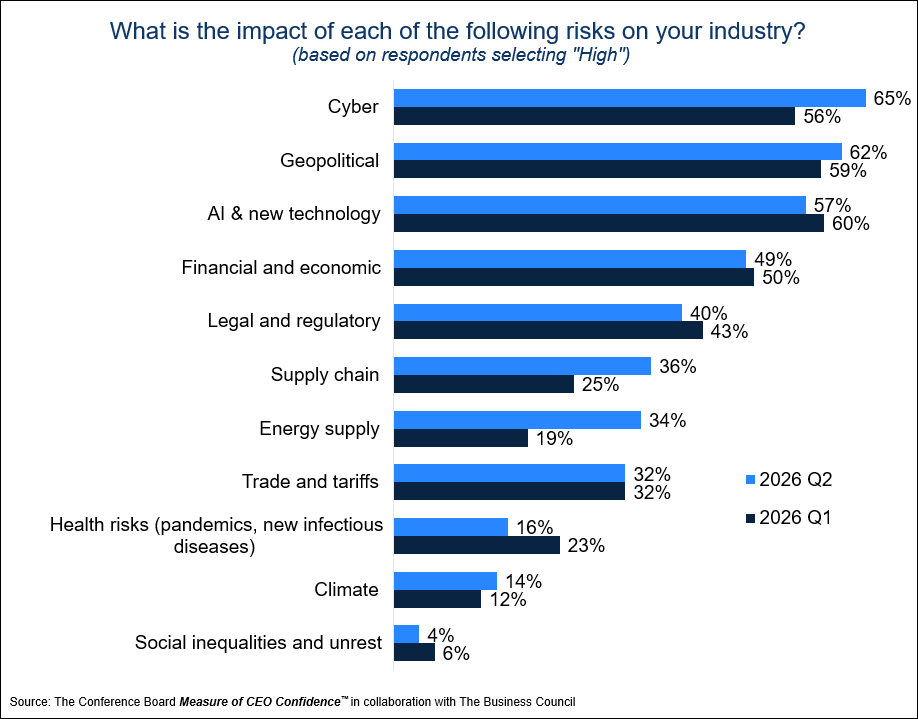
Among top business risks impacting their industries, CEOs became more worried about cyber risks, with nearly two thirds ranking it a top risk in Q2. Geopolitical and AI & new technology risks also remained top concerns. Risks associated with supply chains and energy rose in importance and intensity in Q2.
Roger W. Ferguson, Jr., Vice Chairman of the Business Council and Chair Emeritus of The Conference Board
Outlook for the Economy Over The Next Six Months; AI is No Big Deal
Like the other data, CEOs looking into the near-term future are now more pessimistic than they were in the first quarter. Now, 40% of CEOs expect economic conditions to worsen. In the first quarter, only 13% of respondents said that.

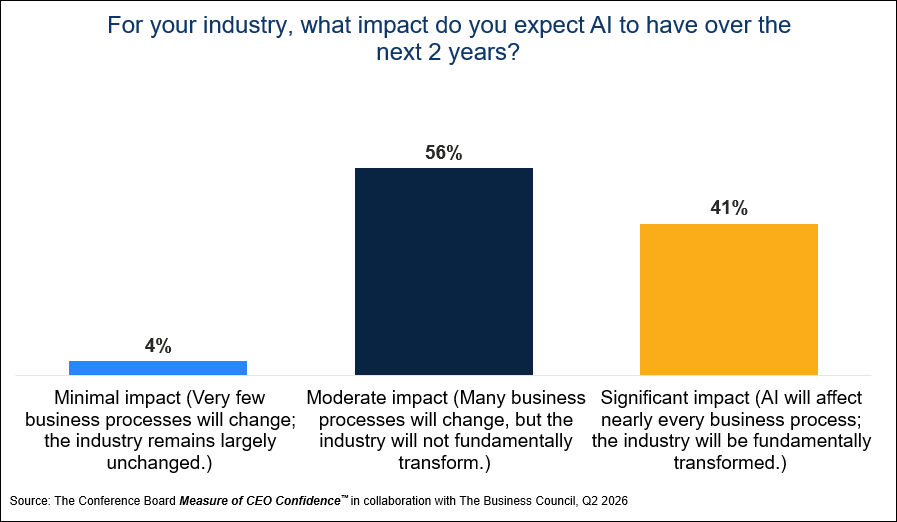
Interestingly, 56% – a majority – of these large-company leaders expect that AI will have only a moderate impact on their businesses with no fundamental industry transformation. And 4% said they anticipated minimal impact, where their industry will remain largely unchanged. But 41% say they anticipate a significant impact on their business and that their industry “will be fundamentally transformed.” Still, this reading was lower than I expected.
About This Survey
The Conference Board Measure of CEO Confidence™ is a barometer of the health of the U.S. economy from the perspective of U.S. chief executives. The measure of CEO confidence is based on CEOs’ perceptions of current and expected business and industry conditions. The survey also gauges CEOs’ expectations about future actions their companies plan on taking in four key areas: capital spending, employment, recruiting, and wages.



Leave a Reply