



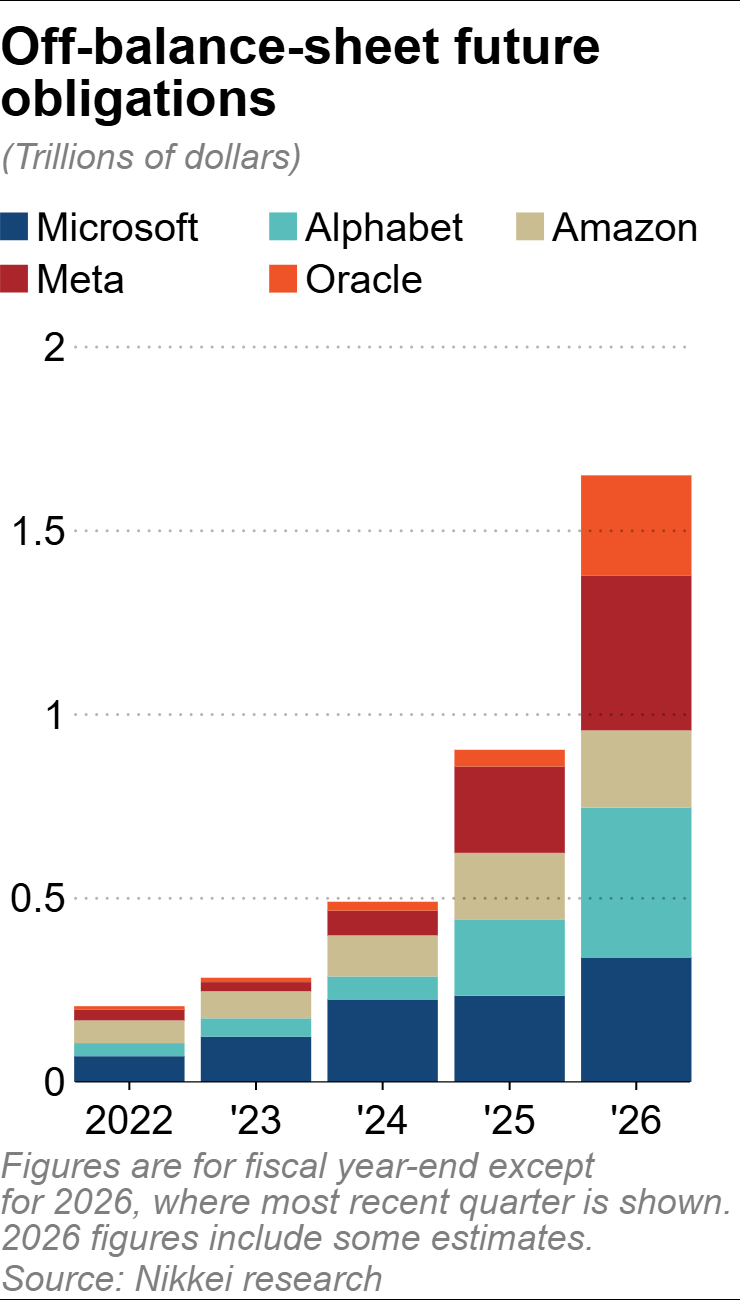
In a surprising exposé resulting from a deep investigation by the Nikkei, we have learned that Big Tech is engaged in questionable practices in order to conceal from investors the true amount of debt they are taking on to pursue building out their AI infrastructure with more and bigger…and more expensive…data centers. How big of a deal is this? Huge! In the last four years, debt not reflected on five of the big AI tech companies’ balance sheets – known as “hidden debt” – totals an estimated $1.65 trillion. Yes…trillion, with a “t”.
See how Big Tech companies get around reporting the true level of AI-connected debt…
Keep in mind, this is on top of the “transparent” debt they do carry on their balance sheets, which is already big enough that investors are getting squeamish. The Nikkei was able to obtain financial statements and other materials on these five big tech companies, including Alphabet (Google), Microsoft, Amazon, Meta, and Oracle. Four of those (all other than Oracle) report their financial results this week.
Again, at the end of the previous quarter, according to the Nikkei’s analysis, the total of hidden off-balance-sheet debt came to a shocking $1.65 trillion. That was in addition to the on-balance-sheet debt of $1.35 trillion. Wow!




How Can SEC-Regulated Public Companies Hide True Debt Levels from Investors Legally?
The Nikkei’s analysis called out in particular the situation of Meta (aka Facebook) relative to the level of hidden debt that most of its investors don’t know about. Meta’s hidden debt rose to $420 billion. That figure is almost triple the amount of debt they transparently show on their balance sheet! Triple!
So how is it possible for these massive Tech companies, who are all SEC-regulated public companies, to get away with hiding debt from their investors? It seems like that should be illegal, doesn’t it?
Creative Methods to Incur Debt Opaquely
Well, not exactly – it’s a little tricky, but let me walk you through it. As you most likely know, there is a mad dash for major AI companies to build up their AI infrastructure. But AI is a resource-intensive business that takes lots of data centers, tons of multi-core graphics processing units (GPU), power generation capabilities, and myriad other computer resources to fuel further AI development.
In the rush to beat the other guy to AI gold, the companies have had to adopt creative methods to both speed up the process of locking up the necessary resources and to do so opaquely to avoid riling up investors concerned about runaway capex (capital expenditures). One of the ways they do that is by entering into long-term purchase agreements for things like GPUs and servers.

One Key, Long-Term Lease Agreements
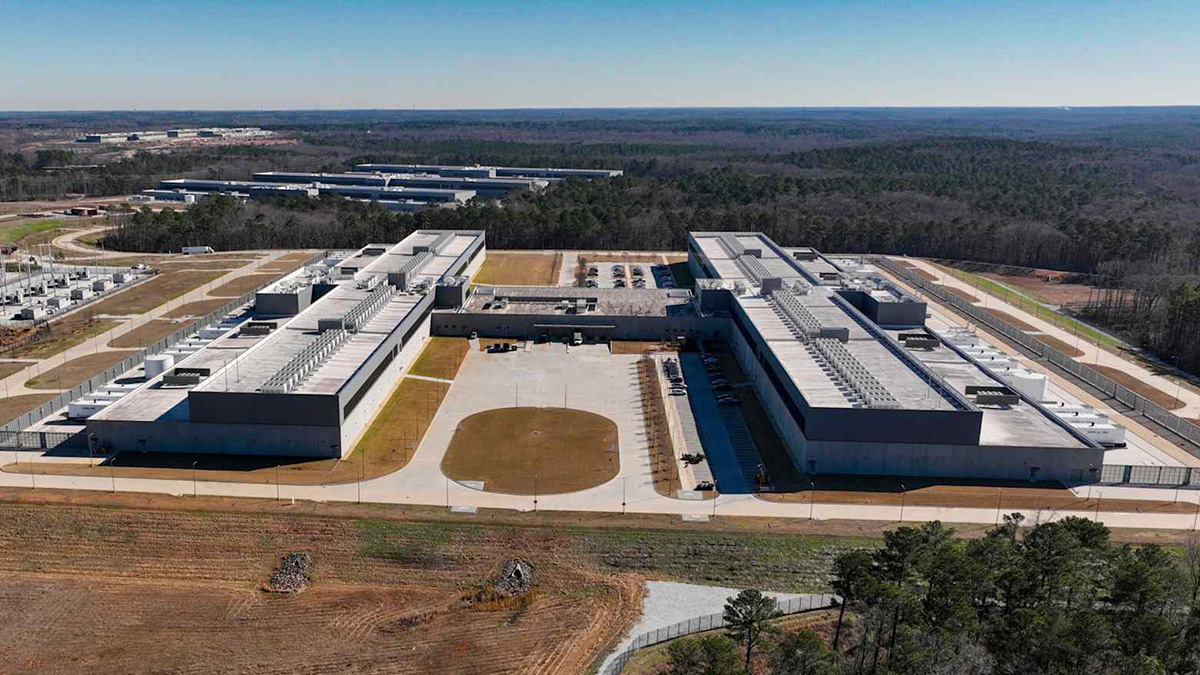
Building data centers, by the way, is not an easy proposition. And it is also an outrageously expensive prospect requiring investments in the billions or even tens of billions of dollars. Keep in mind, none of these companies are in the data center building business, so they have to partner with these specialized companies.
One of the ways an Amazon or Google does this is by entering into lease agreements with data center operators, again often over long time periods. This allows them to keep initial costs down with often large amounts of “future” obligations.
Accounting Rules Provide for This
Says the Nikkei: “Some of these are arrangements where the [data center] operator provides the land, buildings and power facilities, which the tech company leases over the long term.”
Under generally accepted accounting rules, GPUs and servers under long-term contracts that have not yet been delivered – as well as lease agreements for data centers that are not yet operational – are treated as off-balance-sheet items, the report pointed out. Mind you, the company is contractually obligated – indebted – for the entire purchase, but needn’t report the entire amount up front on current balance sheets.
‘Stargate’ Drives Oracle’s Hidden Debt to $273.3 Billion
As an example, the report pointed to Oracle, which is in the process of building a large data center project called Stargate in partnership with OpenAI. This project makes liberal use of lease agreements with external operators. The report notes that Oracle’s hidden debt rose to $273.3 billion by the end of May. This is a greater than 30-fold increase in debt in four years. But you wouldn’t know it from looking at their balance sheet.
When investors are concerned about a company’s debt level, they turn to the balance sheet where such information is typically disclosed. But the neat trick is that by engaging in the process described in the report, the companies do not report such debt on the balance sheet. Rather, they report it in annotations, notes, or footnotes in their massive quarterly earnings reports. This is allowed under existing accounting rules, and many professional analysts or investors are aware of this. But retail investors may be fooled by this trick and find it hard to know just what the actual level of risk the company is truly taking on with AI.
Voices are Rising to Warn Investors
Only now are voices rising to warn about the practice. In a recent report to its investor customers, Morgan Stanley analyzed the practice in detail. Similarly, in February, Moody’s Investors Services warned its customers in a report “that commitments for leases yet to begin were ballooning.”
What are these big Tech companies thinking, and why do they feel the need to hide the true level of their commitment? These massive players believe that the future level of earnings they will enjoy when AI becomes a success will exceed the debts they are incurring now to get there. However, it is increasingly obvious that investors are questioning whether the collective investment in AI is so high now that it exceeds any reasonable likelihood that revenues will be substantial enough to cover it.
Incidentally, the Nikkei reached out to each of these companies for comment on this story. They all declined to comment.
Big Tech Partners with Investment Companies to Carry the Debt Load
The exposé also revealed yet another new tactic being employed by Big Tech. In presenting an example, again from Meta, the report discovered that the Big Tech companies are engaging private equity and large U.S. investment firms as partners to share the start-up debt burden. Meta has partnered with Blue Owl Capital to build a massive data center in Louisiana – a project that was expected to have development costs of $27 billion.
Meta agreed to take a 20% stake in the operating company, as well as to sign a long-term lease agreement. In so doing, it secured the data resources, but also increased its “hidden” debt, as most of this is off-balance-sheet indebtedness.
Meta Had to ‘Sweeten the Pot’ to Get Investors to Buy In
But here’s the kicker…Meta needed to “sweeten the pot” to encourage the partners to join in this deal. And so it has signed a contract with Blue Owl Capital “guaranteeing investors’ losses if the data center becomes unnecessary and the lease is terminated.” Oh, and the company has now announced that its total investment in the facility has almost doubled to $50 billion.
On top of all of this, Big Tech has been busy issuing corporate bonds (debt) and new shares of stock (equity) to raise funds to invest in AI’s future. They are doing this because the investment level required exceeds their earnings. Also, there have been substantial fundraising efforts with institutional investors.
Big Tech is ‘All In’ on AI; But Real Debt Levels Will Eventually Have to Be Reported
To borrow an expression from the Texas Hold ‘Em poker game…these players are going “all in” on AI. But as time goes by and these data centers begin to come online, reportable debt levels will have to rise. Hidden debt will quickly become very visible.
And if there is any hiccup at all, such as AI adoption is slower or lower than anticipated…or the segment experiences less utilization than projected, then the asset values underpinning these titanic debts can collapse – leading to instant losses.



Brilliant, easy to Grok analysis!
Thanks Franklin!