



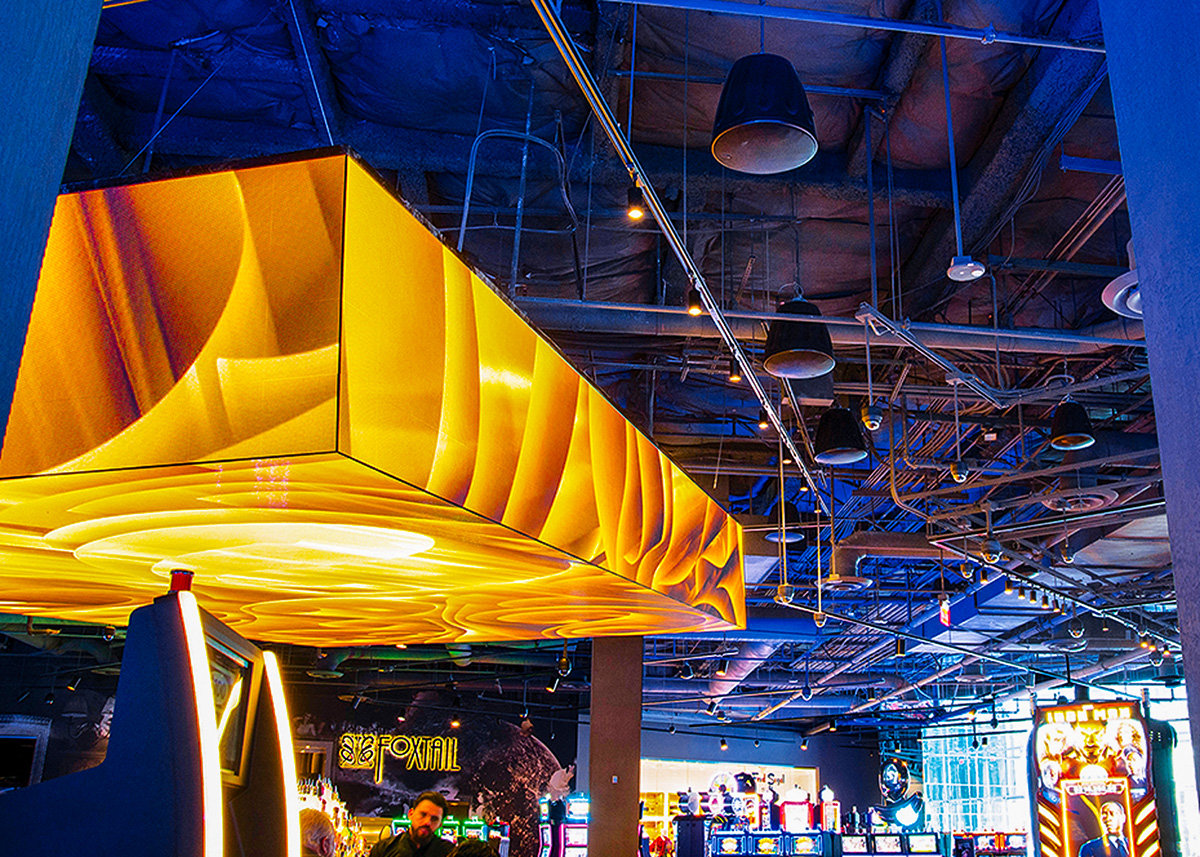
SoundTube says building design trends are changing, and integrators need to recognize the new standard in commercial space design in order to adjust system configurations to deliver the best performance for the greatest client satisfaction possible. Specifically, the company notes that exposed-structure ceilings – once a limited funky or trendy design subset- are now mainstream or the “standard” in retail, hospitality, fitness, and mixed-use commercial spaces.
And that reality calls for some new and thoughtful audio system design considerations.
See more on SoundTube’s recommendations for optimal system configurations…
Exposed-structure ceilings look cool, but they can introduce some new sonic challenges that demand integrators focus attention on coverage control, intelligibility, and installation efficiency. In the past, high-quality in-ceiling speakers mounted in drywall offered a degree of enhanced predictability in sound coverage. However, today, many, if not most, installations don’t provide for that traditional style of installation, forcing integrators to consider a different approach.



Acoustics Can Be Changed in Sonically Vexing Ways
If your installation involves a facility with exposed-structure ceilings, know that they can change the acoustics in sonically vexing ways. Often, for example, they place the point source further away from the coverage zone, are often in spaces with higher ambient noise, and they can feature irregularly placed reflective surfaces, making sound quality and coverage unpredictable.
Not to mention that, in spaces featuring exposed-structure ceilings, not only is the building structure visible, but system hardware is usually visible as well…complicating the installation.
Spaces Demand System Flexibility
SoundTube also notes that many spaces demand an unusual level of system flexibility. For example, the company says, restaurants may need to transition from background music during the daytime hours, only to switch to more prominent evening entertainment. Fitness centers, they note, operate at consistently elevated volume levels. And retail environments rely on both background music and distributed messaging blended in for brand reinforcement.
The company notes that rarely is the design objective in these spaces maximum output. Rather, it suggests the goal should be to achieve uniform coverage free of annoying hotspots and dead zones while maintaining a clean architectural presentation.
For Many, Pendant Speakers are the Answer
For all of these reasons, more integrators are turning to distributed pendant speakers as the best solution to meet these challenges. By paying attention to details, integrators have found that pendants provide a predictable coverage geometry and allow them to relatively easily maintain consistent spacing and sound output across areas of just about any size or shape.
The challenge in open-ceiling design isn’t simply achieving sufficient level. It’s delivering consistent coverage in spaces where ceiling height, reflective materials, and changing use patterns all influence how sound behaves. Dispersion control becomes a design tool.
Peter Melvin, SoundTube Vice President
Integrators Should Check Out the SoundTube RS600i
SoundTube suggests integrators might want to check out its RS600i pendant loudspeaker, which it has engineered specifically for the new reality of exposed-structure ceiling designs. It is a two-way ported design with a 6½” polypropylene woofer and a 1″ convex titanium tweeter with Ferrofluid cooling, mounted to a proprietary cast-aluminum baffle and heat sink. The company says the RS600i delivers rich, precise low-frequency performance down to an incredible 58Hz (±10dB).
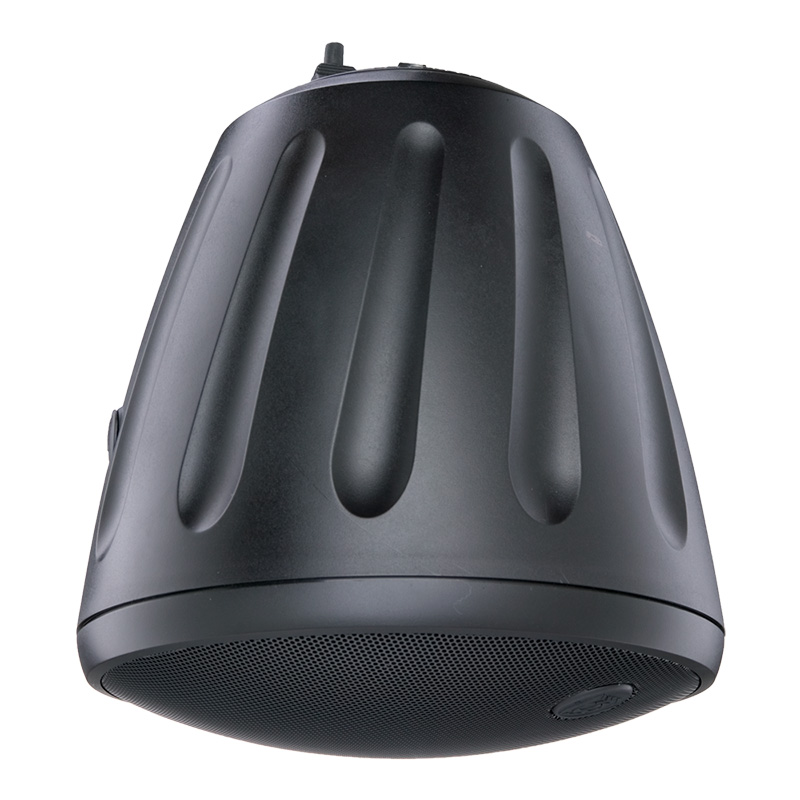
The company claims that the RS600i maintains a consistent 100° dispersion pattern across the critical 2k-10kHz frequency range – a claim they say has been independently verified. This dispersion spec, by the way, the company says is key to your installation delivering a higher grade of speech intelligibility, along with overall perfectly balanced music reproduction.
A Cabinet Construction That Optimizes Controlled Acoustic Performance
The RS600i features SoundTube’s patented BroadBeam® waveguide technology for consistent off-axis performance. This, coupled with its ZeroReflection™ enclosure, supports enhanced cabinet rigidity and more controlled acoustic performance in exposed-structure installations.
Other specs:
- Measured sensitivity – 88.5dB (1w at 1m)
- 90 watts of continuous power handling and a maximum output of 108 dB at 1 meter
- Six-position selectable tap switch for 25V, 70.7V, and 100V distributed systems; Includes a transformer bypass position for 8Ω operation
Where Clarity and Even Distribution are Priorities
Those sensitivity and power handling and output specs above define a pendant speaker performance profile that makes it perfect for background to mid-level SPL environments, “where clarity and even distribution are priorities.”
For installations requiring even more low-frequency energy, SoundTube recommends a separate subwoofer, such as their RS1201i-SuperT™ model with bass down to 32Hz and peak output of 113dB. In this configuration, integrators can scale a distributed system for a more music-forward application while maintaining coverage integrity.
The RS600i is available in both a white or black finish from SoundTube’s authorized distribution network.
For More Information
To learn more about SoundTube and its entire line, visit SoundTube.com.



Leave a Reply