



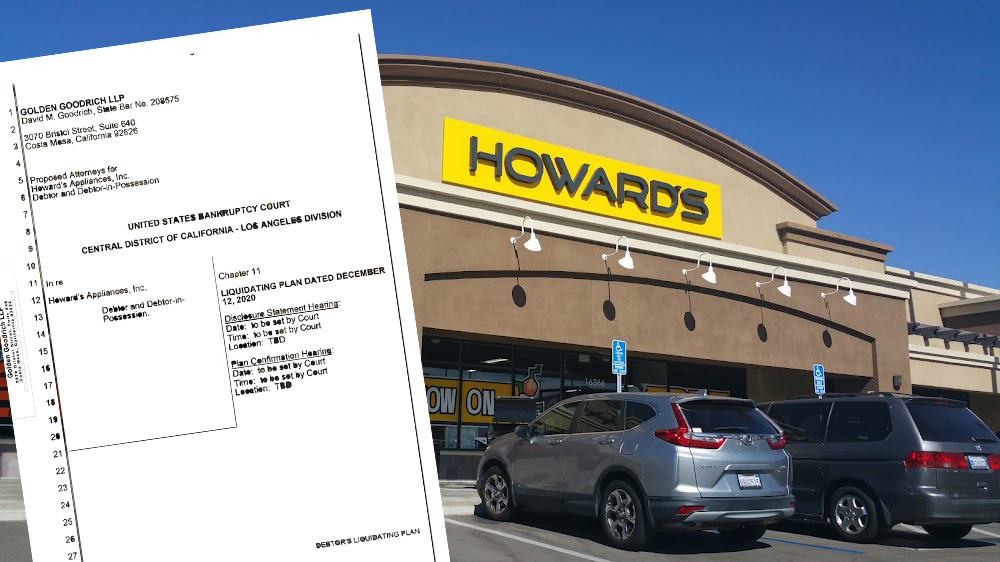
Howard’s Appliances, Inc. has filed for bankruptcy, and we now know the path the company’s directors have chosen to take in this transition for the company. In addition to filing a comprehensive Voluntary Petition for Non-Individuals Filing for Bankruptcy, along with a series of attachments containing, among other things, huge inventory lists, the Howard’s team also added a series of Motions requesting the court grant immediate “Hearings on Emergency Basis.”
What was I able to glean from literally hundreds of pages of document filings? Read on…
See more on the Howard’s Appliance bankruptcy filing…
It was just one week ago when I told you about the sudden closing of all Howard’s Appliance locations, a leading independent TV Appliance Mattress retailer in Southern California with 17 locations at its peak. These abrupt closings took place nearly 80 years after its founding and just one week after Black Friday.




Howard’s Lawyer Preparing a Normal Chapter 11 Filing…Or is it Something Else?
In my report, I mentioned that the lawyer retained by the company to shepherd its bankruptcy filing through the courts, David Goodrich of the Golden Goodrich firm in Costa Mesa, CA, said he was filing for Chapter 11 bankruptcy protection on behalf of Howard’s. Here is what I wrote then…
Goodrich went on to say the company will file for a Chapter 11 bankruptcy, which provides the debtor protection from creditors to continue to operate (under court supervision) while creating a plan for court approval to ultimately exit bankruptcy as a viable business. The lawyer declined to give any specifics of the company’s situation, preferring to allow the filing to speak to those matters.
See: After Nearly 80 Years of Operations, Howard’s Appliance Suddenly Closes All Locations
A Chapter 11 Filing Typically Means the Company Will Continue Under a Court-Approved Plan
In a way, David Goodrich’s comment was confusing. As I noted, he said clearly he was going to file for a Chapter 11 bankruptcy. This form of bankruptcy is commonly referred to as a “reorganization” filing, where the debtor remains in control (under court supervision) while preparing a plan that would allow them to exit bankruptcy – if approved by the judge – and continue as an ongoing entity.
There are a total of six different forms of bankruptcy. Two of them are most commonly used by a company depending on how it wishes to proceed. Those two versions are: Chapter 11 (reorganization) and Chapter 7 (liquidation). In this case, Howard’s chose a more rarely utilized form of bankruptcy – sort of a hybrid version – known as a “liquidating Chapter 11” bankruptcy.
Why Choose a ‘Liquidating Chapter 11’ Bankruptcy?
Why choose a liquidating Chapter 11 over a Chapter 7 (liquidation) bankruptcy? In a Chapter 7 bankruptcy, a trustee assigned by the court immediately takes over all of the assets and begins the process of liquidating them, disbursing the proceeds to creditors, and finalizing the closing of the business. However, in a liquidating Chapter 11 bankruptcy, the debtor retains a court-supervised management of the process…referred to as debtor-in-possession…much like in a traditional Chapter 11. However, the ultimate goal of the plan submitted by the debtor is solely to dismantle and shut down the business, not to create a new business plan for a revitalized, ongoing business.
That, in fact, is the plan that Goodrich filed on behalf of Howard’s. With the court’s likely approval, in a few months, Howard’s will be gone for good.
Current Situation – Assets and Liabilities
In any event, we’ve learned a lot in this filing as to what happened to bring Howard’s Appliance to this end. According to the filing, the company has listed total assets of $11,483,285.99. On the other side of the balance sheet, it lists total liabilities of $17,188,002.18. As you can see, liabilities are more than $5.7 million more than assets. Houston, we have a problem.
In that total liability figure, more than $6.7 million consists of priority claims secured by property. Another $273,500.45 represents priority unsecured claims. And fully $10,168,305.91 are nonpriority, nonsecured claims – the group of creditors that usually are paid only a small percentage of what they are owed from what’s left after all the secured and priority claims are paid.
Receivables and Inventory
As far as the assets go, the company reported an accounts receivable asset of $1,070,481.00. Unfortunately, the largest share of this receivable amount – $927,124.00 – is receivables that are over 90 days old. The older the receivable, the lesser the likelihood of collection.
Furthermore, the company reports inventory valued at $8,100,000.00. The reality is that inventory held in a bankruptcy situation is a little like decaying fruit – it incrementally drops in value each day it continues to be held. I’ve looked over the pages and pages of inventory. Much of it is repair or accessory parts for specific brands and models, and will likely only draw a small percentage of its original value.
List of Top 20 Unsecured Creditors
The filing provided a list of the top 20 unsecured creditors. It includes some big name companies, holding a large amount of Howard’s Appliance debt.
| Rank | Unsecured Creditor Name | Amount | Notes |
|---|---|---|---|
| 1 | GE Appliances Retail | $1,421,717.17 | |
| 2 | LG Appliances | $1,129,221.36 | |
| 3 | Electrolux Home Products | $894,411.54 | |
| 4 | Fox 11 (KTTV) | $562,521.77 | Advertising |
| 5 | R&B Wholesale | $431,247.94 | |
| 6 | Themador | $274,724.24 | |
| 7 | California Dept. of Tax & Fee Admin | $273,500.45 | Taxes |
| 8 | LG Signature Kitchen Suite | $262,101.24 | |
| 9 | Samsung Electronics | $239,564.50 | |
| 10 | Top Staffing Solutions, Inc. | $203,841.43 | |
| 11 | American Express | $197,120.11 | |
| 12 | Zephyr Ventilation | $173,565.97 | Services |
| 13 | 2121 Main Street LLC | $157,743.24 | Rent |
| 14 | Miele | $150,628.44 | |
| 15 | Angels Baseball L.P. | $150,000.00 | Advertising |
| 16 | Torrance Town Ctr. Assoc. | $143,421.99 | Rent |
| 17 | KTLA | $138,586.37 | Advertising |
| 18 | H. Taylor Investments, LTD | $121,033.34 | Rent |
| 19 | Viking Range LLC | $118,269.00 | |
| 20 | Google, LLC | $117,094.75 | Advertising |
It is important to remember that this list of unsecured creditors is not a comprehensive list of all of the unsecured creditors holding Howard’s debt. It is just the top 20. The entire list is much, much longer.
List of Secured Creditors
This list of secured creditors will get priority in any asset distribution. That does not usually mean they are guaranteed to be made whole, but they are in a much better position than the unsecured creditors listed above. Note that this list is in alphabetical order, not ranked by debt level.
| Secured Creditor Name | Amount | Notes |
|---|---|---|
| BSH Home Appliances | $295,123.24 | |
| De Lage Landen Financial Services | $3,017.04 | |
| Fisher and Paykel Appliances | $14,132.57 | |
| Haier US Appliance | $1,418,813.17 | |
| Murrietta Town Center Retail | $82,735.75 | Judgment lien |
| Northpoint Commercial Finance | $3,753,158.71 | |
| Wells Fargo Vendor Financial | $5,137.45 | Leased image equipment |
| Whirlpool Corporation | $1,172,079.89 | |
| TOTAL | $6,744,195.82 |
After 79 Years of Recessions, Wars, and Poor Economies, How Did Howard’s Appliance End in Bankruptcy?
So I reported in my previous article that Howard’s blamed tariffs and declining consumer spending as the principal factors that drove its business to bankruptcy. You may have seen a commenter on my article who disagreed with that notion – suggesting that this day has been coming for a long time. I’ve heard similar comments from others, including multiple Howard’s employees and customers.
Those issues named by the company (tariffs & slack consumer spending) certainly may have been contributing factors. Recently, home builder Lennar Corp. said its profits dropped by 50%. The company blamed material cost inflation due to the administration’s tariff program, the elevated unaffordability of homes, and softening consumer demand. So these issues do exist and are impacting companies.
A Clue Emerges in the Filing as Howard’s Reports Its Recent Business Performance
But I also believe that the commenter on that article also had a point. The fact is that bankruptcies like this rarely happen overnight. And the bankruptcy filing appears to address that, revealing that the company has experienced year-over-year revenue declines over the last three years.
| Fiscal 2023 | vs Prev Year | Fiscal 2024 | vs Prev Year | Fiscal 2025 (to 12/10/25) | vs Prev Year |
|---|---|---|---|---|---|
| $29,432,118 | – | $21,029,566 | -29% | $16,201,150 | -23% |
Keep in mind, the administration’s tariff plan didn’t even begin to roll out until April 2025. But Howard’s revenue declines began well before that time. So perhaps this is one clue as to the issues that brought the company to this point.
Another Clue is Found in the Declaration of David Steinhafel
As part of its bankruptcy filing, Howard’s made several “emergency motions” common in bankruptcy. In other jurisdictions, these are often referred to as “first day motions” and are immediate actions the debtor is requesting of the judge to order, allowing it to keep operations open and running during the bankruptcy. In Howard’s case, they filed several motions:
- Emergency motion for Order Authorizing Continued Use of Pre-Existing Cash Management Systems
- Emergency motion for Order Pursuant to 11 U.S.C. §366: (A) Prohibiting Utility Providers From Altering, Refusing, or Discontinuing Service; (B) Deeming Utilities Adequately Assured of Future Performance; and (C) Establishing Procedures for Resolving Requests for Additional Adequate Assurance of Payment
- Emergency motion for Order Limiting Notice of Certain Matters Requiring Notice to Creditors
- Emergency motion for Order Authorizing Rejection of Unexpired Leases and Executory Contracts
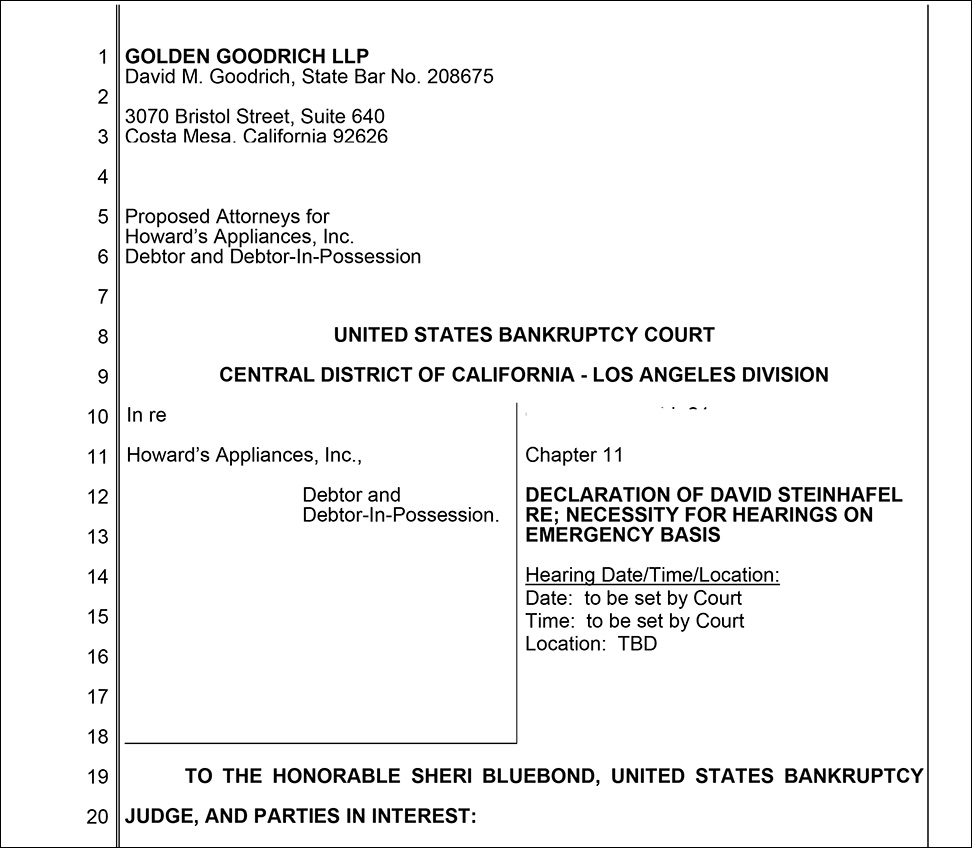
As part of entering these motions, the court requires a Declaration by a company representative in support of these motions. New owner of Howard’s, David Steinhafel filed a declaration that requested expedited (emergency) hearings on these important and necessary motions.

Overly Aggressive Expansion May Have Been ‘Too Ambitious’
What I found to my surprise is in the declaration by Steinhafel, he offered yet another suggestion as to how Howard’s may have gotten itself into trouble.
At the direction of former management, Howard’s expanded its footprint into new regions in Southern California. Howard’s expansion may have been too ambitious. Although revenue increased with the opening of new stores in new markets, sales did not meet projections and Howard’s financial difficulties began to mount. In an effort to combat losses, Howard’s retained professionals to explore restructuring and cost-cutting concepts with the goal of returning to profitability. Despite these efforts, Howard’s financial woes persisted.
David Steinhafel, Declaration of David Steinhafel re; Necessity for Hearings on Emergency Basis
Even Turnaround and Retail Experts Couldn’t Turn Howard’s Business Around
The new owner also informed the judge that Howard’s was an employee-owned and operated company, and in April, the Howard’s Employee Stock Ownership Plan (“ESOP”) sold its equity interest to H Retail Holdings, a new holding company formed by turnaround and retail executives. Yet, even that expanded team of experts apparently wasn’t enough.
Despite the dramatic turnaround effort implemented, tariffs and consumer spending deterioration quickly crippled Howard’s ability to remain competitive while maintaining its impeccable standard for quality. On the eve of the filing of its voluntary petition, Howard’s made the difficult decision to permanently shutter operations, lay off its workforce, and seek relief under chapter 11 to liquidate all assets, pay creditors from the liquidation of its assets, and dissolve a business that has been a staple in Southern California for nearly 8 decades.
Steinhafel Declaration
The Court Case is Moving Quickly
Whatever the cause, the court case is proceeding quickly and the judge has already preliminarily approved all of Howard’s emergency motions. Meanwhile, the company is quickly collecting all inventory from its stores, moving it to the main warehouse in City of Industry, California, and fully exiting all retail store locations. The plan is to have an auction or some type of bulk sale of all inventory, fixtures, and any other remaining assets as quickly as the court will allow.
Says Steinhafel to the court: “…the Debtor estimated a meaningful distribution will be made to unsecured creditors.”



Howards did not deliver the
Howards accepted full payment for the SDS refrigerator $10,000 that I purchased from them months before declaring bankruptcy. I was advised they had the refrigerator in the warehouse and would deliver it soon. Technically that refrigerator is mine and not their’s. They have effectively committed fraud.If they are allowed to continue operating as you stated by moving inventory to a central warehouse, they are stealing my property. I would believe there maybe other individuals that are in the same boat. The court should order them to deliver all paid purchases of undelivered property.
I, too, ordered a refrigerator which should have been delivered before the Bankruptcy. How do we state a claim for items paid, but not delivered, because these should not be auctioned because they do not belong to Howards.
It’s a scam. The steinhafel. Own several furniture stores in Wisconsin. Named the steinhafel and own several properties. They mad all their furniture stores employed owned. And probably pulled all the money out. One of the uncles. Was the former ceo of target. And almost destroyed. Target People say. This family. Is trying to pull. Cash. Out of theses. Companies. And destroying the employees who worked hard. To build it. They all drive teslas It’s a money scheme. To benefit the steinhafel family. The attorney general needs to get involved