



Company Blames a ‘Challenging Residential Market’ & ‘Weaker’ Resi Demand
ADI Global Distribution Inc. (ADI) [NYSE: ADIG] saw the value of its stock collapse by 50% on Thursday after the company released the financial results for its fiscal 2026 third quarter, the period that ended on October 3, 2026. While revenues increased in the quarter, the company surprised market analysts with a significant net loss of $655 million…the kind of surprise they don’t like.
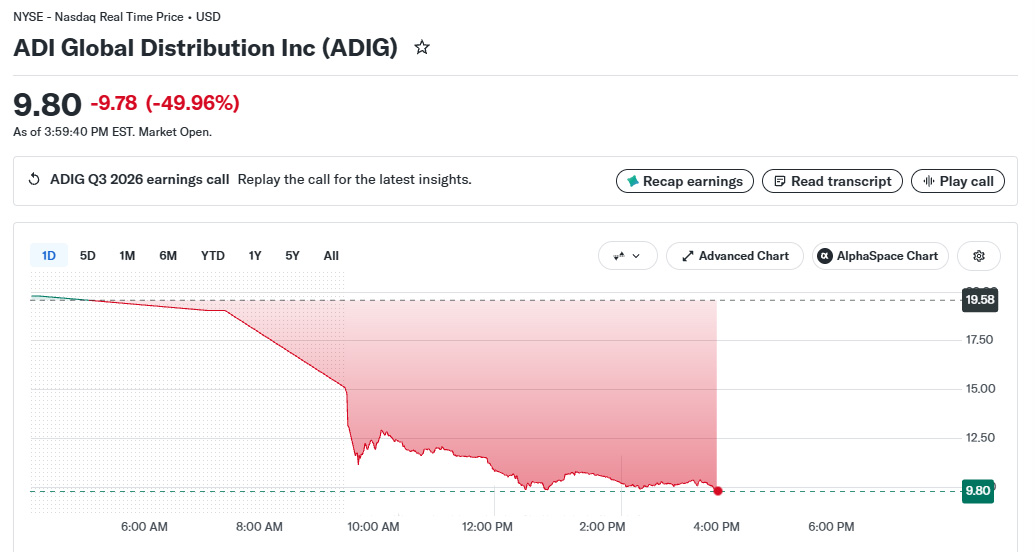
Also, the company revised its forward-looking guidance for fiscal fourth-quarter performance downward, to a number well below analysts’ consensus estimates. The company also revised its guidance downward for the full fiscal year. As a result of this bitter pill for analysts to swallow, shares of ADIG dropped from $19.58 per share (Wednesday closing price) to close at $9.80…a decline of 50%.
Learn more on ADI’s Fiscal 2026 Q3 results…
As most Strata-gee readers know, ADI is a large low-voltage distributor that serves both the residential and commercial or professional channels. However, the majority of its business is largely centered on commercial security and facility protection products. Until August this year, it was part of Resideo Technologies, but was spun off as an independent company on August 3, 2026.




Before Going Independent, Acquires SnapOne
In April, shortly before the company split in two, Resideo Technologies had acquired SnapOne, a manufacturer and distributor of smart home products, including IP security cameras. Resideo then assigned SnapOne to its ADI division. Perhaps I sensed the future, as my subheading at the time was, “Will Merging Two Stagnant Businesses Reignite Growth?”
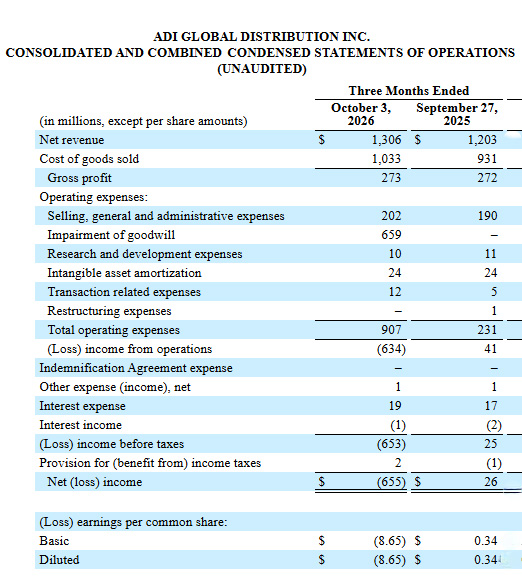
I suppose the company would argue, “Yes,” as revenues in Q3 of fiscal 2026 did, in fact, increase. The company reported net revenue of $1.31 billion in the quarter, up $100 million or 8.6% compared to net revenues of $1.2 billion in the same quarter last year. The company did note that it benefited from two additional selling days in the quarter this year. They also noted that this year benefited from “an easier comparison with the prior-year quarter,” due to business disruption last year from a transition to a new ERP system.
Higher Security Sales, Lower Residential AV Sales
ADI management noted that the company experienced “[H]igher sales in security, professional audio-visual, fire and life safety and data communications.” However, this was partially offset by “lower residential audio-visual sales, primarily reflecting continued weakness in the U.S. housing market.”
The company’s lack of success in the residential AV business is troubling. Also troubling, the company reported a gross margin of 20.9%. This gross margin result was down 170 basis points from the gross margin of 22.6% in the third quarter of fiscal 2025, a significant decline in GM.

Unfavorable Customer and Product Mix Hurt Gross Margins
What does ADI say was the reason behind this disappointing result? “The decline [in gross margin] primarily relates to unfavorable customer and product mix and inventory-related charges, as well as the comparison with a temporary prior-year tariff benefit when selling-price increases took effect ahead of higher inventory costs.” So we see that the company was forced to take unfavorable inventory charges during the quarter. By the way, that unfavorable “customer and product mix” is specifically clarified by the company as referring to the residential business.
The company said it was able to cut some overhead, primarily in research & development, by implementing layoffs, as well as some other operating expense reductions. However, selling, general, and administrative expenses (SG&A) ballooned by $12 million. This SG&A expense increase, the company said, was largely due to real estate and distribution consolidation, merit and cost inflation impacts, investments in third-party spend, increases in finance, legal, human resources, information technology, “and other standalone costs.”

The Big Megillah
But the Big Megillah impacting the quarter’s financial performance was largely a self-inflicted wound. The company was forced to take a $659 million charge against earnings to write down the value of its SnapOne acquisition. By the way, I’m saying SnapOne, but the company is saying the write-down was “triggered by continued weakness in the residential market, together with lower projected earnings and cash flows…”
ADI also lumped in “…declines in our stock price and market capitalization,” as impacting its cost structure.
But, no question about it…that write-down resulted in the company booking a loss from operations of $634 million in the quarter this year, which is much worse than an income from operations of $41 million the company booked in the same quarter last year. Similarly, it resulted in a net loss of $655 million, which is also much worse than a net income of $26 million in Q3 of fiscal 2025.
A Setup for More Disappointment to Come
As the company continued with its narrative on the results in the quarter, I began to sense a setup. Says ADI’s announcement, “The revised projections reflect continued residential market weakness affecting demand for Exclusive Brands products and unfavorable product and customer mix.” Yes, this is the setup to lead into the downward revisions the company announced for its forward guidance on future performance.
By the way, just so we are all clear, when the company refers to Exclusive Brands, they are largely referring to the brands it acquired when it purchased SnapOne. These brands include Control4, OvrC, Araknis Networks, Episode, Binary, SunBrite, Access Networks, Luma, and more.

Performance ‘Below Our Expectations’ Due to a ‘Continued Challenging Residential Market’
Third-quarter profitability was below our expectations, primarily reflecting a continued challenging residential market and weaker-than-anticipated demand and product mix in our Exclusive Brands offering. A greater share of commercial sales from lower-margin national accounts and products also weighed on profitability. These results fell short of our standards, and we are lowering our full year outlook to reflect the third-quarter shortfall and further weakness in Exclusive Brands in the fourth quarter.
Rob Aarnes, ADI President and CEO
Well, I have to hand it Aarnes; he’s not trying to sugarcoat it. Basically, he’s saying these results were bad. Not only that, but for the foreseeable future, they are not getting any better. The CEO went on to say the company is continuing to find ways to further lower its costs “…to align our cost structure with current demand trends.”
The company mostly blames the underperformance of its Exclusive Brands on the sluggish housing market, which it does not expect to rebound in the fourth quarter or even into 2027. It plans to stimulate demand for the residential business by offering its many Exclusive Brands into commercial and national project accounts where it has strong relationships. Yet even this is expected to take time to realize significant growth.
Reduced Guidance Disappoints Investors
The company released revised fourth-quarter and full-year guidance to reflect the continuing slack demand from the residential channel for its Exclusive Brands. In the fourth quarter, the company expects revenues to come in at $1.11 billion to $1.13 billion. With the midpoint falling to $1.12 billion, this figure is well below analysts’ consensus estimate of revenues at $1.21 billion.
For full-year revenue guidance, the company projected revenues to come in between $4.91 billion to $4.93 billion. Here again, at the midpoint of $4.92 billion, the company’s outlook remains well below analysts’ consensus estimate of $4.97 billion.
Investors Did Not Like What They Heard
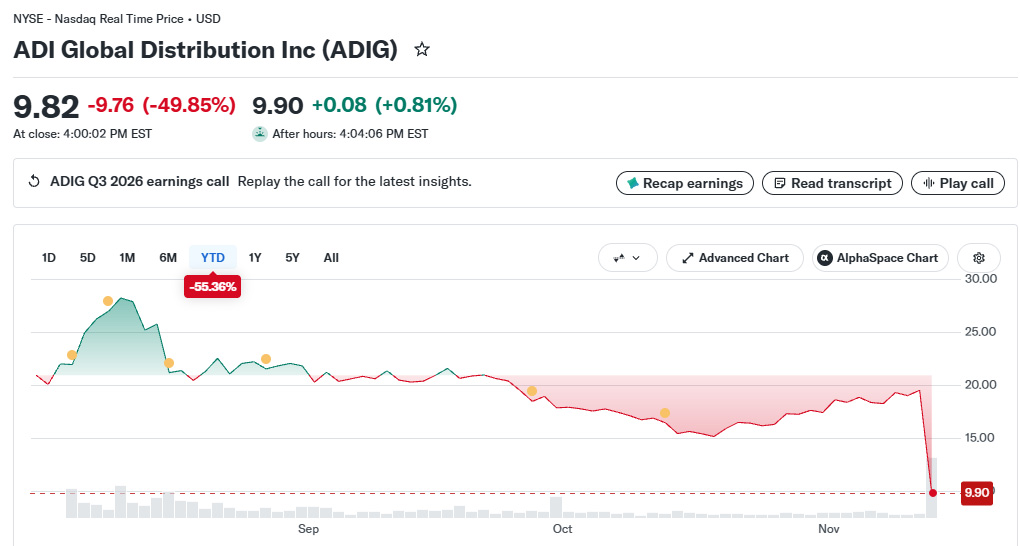
Investors apparently did not like what they heard, as the value of ADIG shares dropped a full 50% to $9.82 per share. The company’s market capitalization was cut in half. In after-hours trading, ADIG shares continued to drop another 1.7% to just $9.65 per share.
To learn more about ADI Global Distribution, be sure to visit adiglobaldistribution.us.



Leave a Reply