



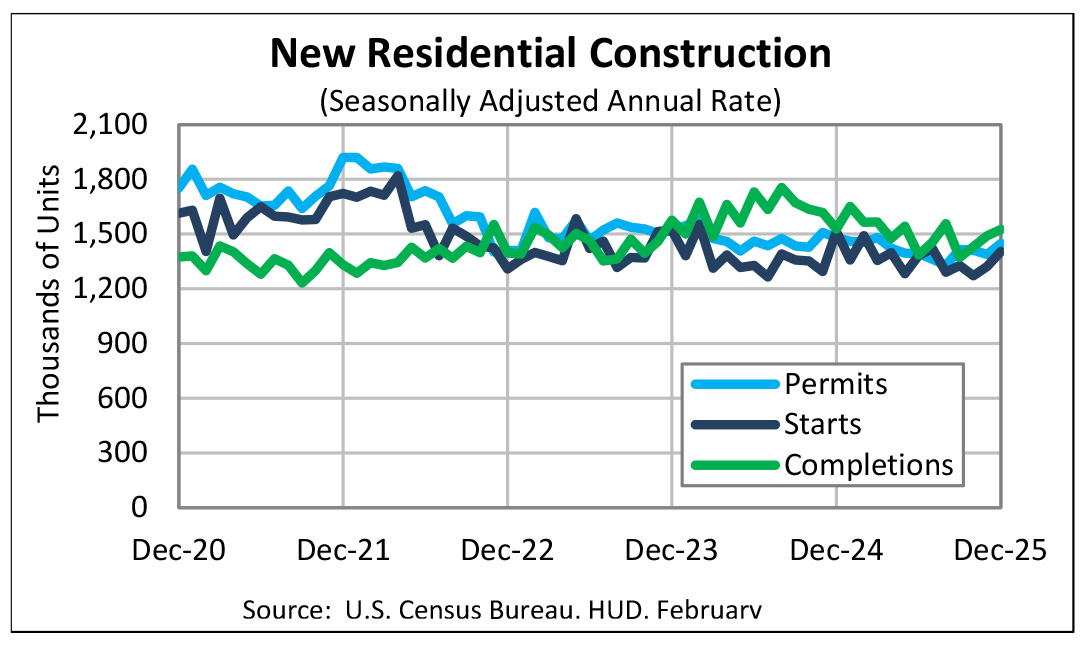
The government is normally a very reliable source of key economic data. Lately, however, it has been thrown into a bit of disarray ever since the first government shutdown, and now again into a second partial shutdown, causing a delay in the delivery of its reports. In any event, we now have December 2025 residential construction data, which shows an increase in housing starts compared to November. However, December’s starts remain below the rate set in December 2024. Starts for the full year of 2025 dropped for single-family and overall starts.
See more on the housing starts data for December…
According to the latest delayed data from the U.S. Census Bureau and the U.S. Department of Housing and Urban Development, total residential construction (including both single-family and multi-family units) – known as housing starts – in December 2025 came in at a seasonally adjusted annual rate (SAAR) of 1.404 million units. That is an increase of 6.2% compared to the revised November rate of 1.322 million units. This is the highest rate of housing starts in the last four months (since July’s 1.420 million), but remains 7.3% below the rate of 1.514 million units started in December 2024.
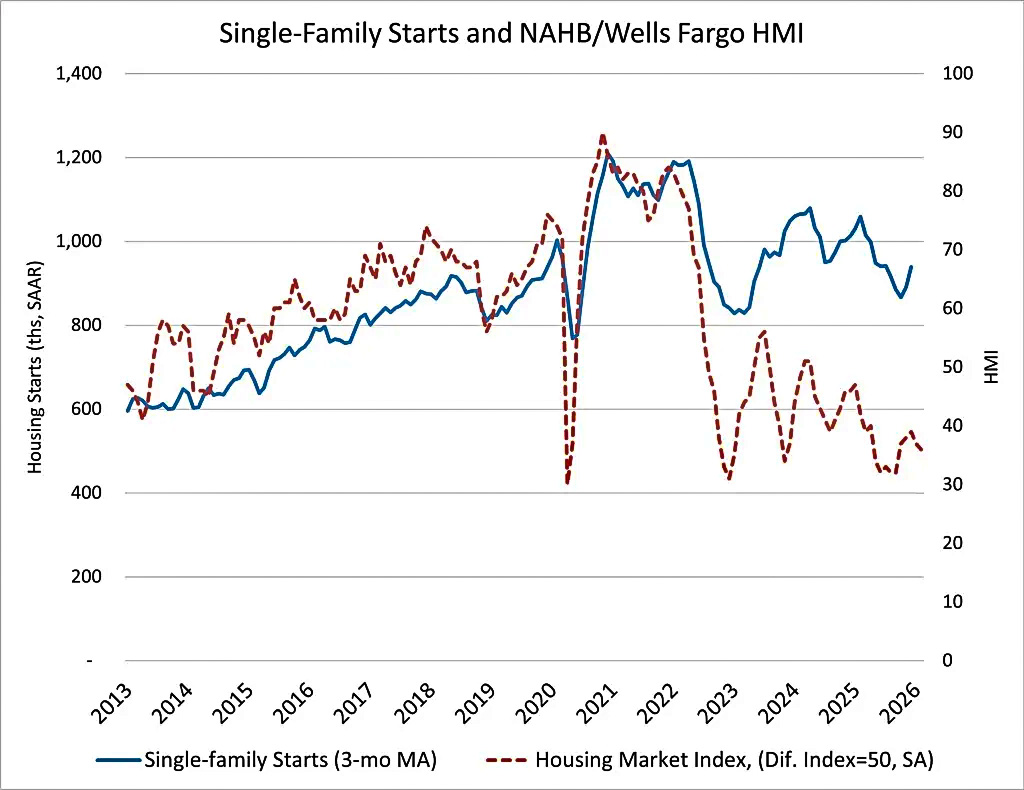
Single-family housing starts in December, a more reliable indicator of economic health for the custom integration industry, came in at a reading of 981K units. This rate is 4.1% higher than the revised November rate of 942K units, but 9.0% below the reading of 1.078 million units in December 2024.




Annual Housing Starts Declined
Although it was nice to see that December bump up in starts at the end of the year, analysts in general were not impressed. Why? The reason they are not impressed is that despite that year-up uptick, overall housing starts were down for all of 2025. In actual numbers (not adjusted), overall starts for 2025 came in at 1.358 million units, down 0.6% compared to 2024’s rate of 1.367 million units.
And in the case of single-family starts, the decline in 2025 as compared with 2024 was even more pronounced. Total 2025 single-family starts came in at 943K units, down 6.9% compared to single-family starts of 1.013 million in 2024.
Big Swings in Regional Results
Despite a strong finish in December, single-family home building dipped in 2025 as persistent affordability challenges continued to weigh on the market.
Jing Fu, National Association of Home Builders
On a regional basis, December 2025 single-family starts fluctuated wildly – the Northeast increased 2.9%, the Midwest dropped 6.1%, the South increased 0.9%, and the West skyrocketed 24.7%. For the whole year of 2025, single-family starts were: Northeast dropped 8.4%, the Midwest increased 1.3%, the South dropped 7.9%, and the West dropped 8.5%.
Building Permits – The Leading Indicator to The Leading Indicator
In most parts of the country, before there can be a housing start, there needs to be a building permit issued. The government tracks these as well, as they represent the leading indicator to the leading indicator (housing starts). The pattern of results for building permits pretty much tracks what we saw in the housing starts pattern.
Privately-owned housing units authorized by building permits in December were at a seasonally adjusted annual rate of 1.448 million units. This is 4.3% above the revised November rate of 1.388 million units, but 2.2% below the December 2024 rate of 1.480 million units.
Single-Family Permits Declined in December and For The Year
Single-family authorizations in December were at a rate of 881K units. This is 1.7% below the revised rate in November of 896K units.
Final results for 2025 – an estimated 1.425 million housing units were authorized by building permits in 2025. This is 3.6% belowthe rate of 1.478 million units authorized by permits in 2024.
The Custom Home Market Grew More Substantially in 2025
For those of you who serve the high-end luxury client, a study by the NAHB showed that housing starts for single-family custom-built luxury homes grew by 5% in 2025. While that might not be a barn-burner, it is way better than the 6.9% decline in overall single-family starts.
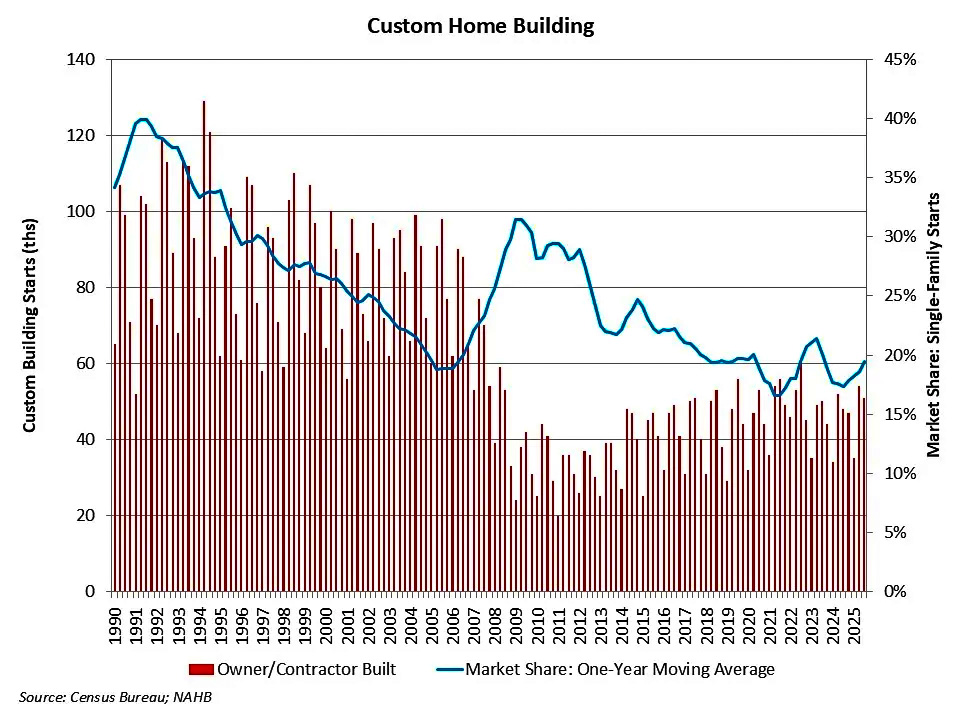
Also noteworthy, the NAHB noted that the market share of custom home building on a moving 1-year average was 19% of single-family homes in 2025. That is not a record; custom-built market share in the second quarter of 2009 was +31.5%. More recently, at the beginning of 2023, it enjoyed a +21% share of the market.
It is also interesting to note that the NAHB says that custom-built homes are more immune from fluctuations in mortgage interest rates, as they often are purchased in cash. However, it warns that they are “…more sensitive to changes in household wealth and stock prices.”



Leave a Reply